
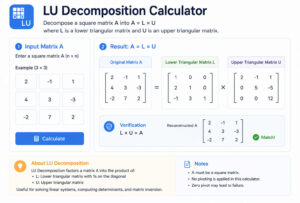
A LU Decomposition Calculator is an online mathematical tool used...
Read MoreLU Decomposition Calculator
Analyze matrices using LU decomposition, determinant calculation, inverse matrix generation, rank analysis, and linear equation solving.
Matrix A
Linear Equation Solver (Ax = b)
Optional: Enter vector b to solve Ax = b.
Determinant
—
Rank
—
Trace
—
Invertible
—
Matrix Properties
Run analysis to view results.
Permutation Matrix (P)
Lower Matrix (L)
Upper Matrix (U)
Inverse Matrix
Solution Vector x
Latest from the blog

Fibonacci Numbers Calculator: What It Is, How It Works, and Why It Matters
What Is a Fibonacci Numbers Calculator? A Fibonacci Numbers Calculator...
Read More
Temperature Conversion Guide: Celsius, Fahrenheit, Kelvin and Rankine
Temperature conversion is the process of converting a temperature value...
Read More
GPA Calculator: Complete Guide to GPA Calculation, Conversion, and Academic Planning
GPA Calculator A GPA Calculator (Grade Point Average Calculator) is...
Read MoreHow to Use the LU Decomposition Calculator
Our LU Decomposition Calculator helps you factorize a square matrix into Lower (L) and Upper (U) triangular matrices using partial pivoting. This tool is useful for students, engineers, researchers, and anyone working with linear algebra problems.
Step 1: Select the Matrix Size
Choose the size of your square matrix from the Matrix Size dropdown menu.
Supported sizes:
- 2 × 2
- 3 × 3
- 4 × 4
- Up to 10 × 10
For example, if your matrix has 3 rows and 3 columns, select 3 × 3.
Step 2: Enter Matrix Values
Input the numbers of your matrix into the grid.
Example:
| 2 | 3 | 1 |
|---|---|---|
| 4 | 7 | 2 |
| 6 | 18 | 5 |
You can enter values manually or paste data directly from Excel, Google Sheets, or CSV files.
Step 3: Click “Analyze Matrix”
Press the Analyze Matrix button to perform the decomposition.
The calculator will automatically:
- Apply partial pivoting if necessary
- Compute the permutation matrix (P)
- Compute the lower triangular matrix (L)
- Compute the upper triangular matrix (U)
- Calculate the determinant
- Determine the matrix rank
- Verify that PA = LU
Step 4: Review the Results
Permutation Matrix (P)
The permutation matrix records any row swaps performed during partial pivoting.
If no row exchanges are required, P will be the identity matrix.
Lower Matrix (L)
The lower triangular matrix contains the elimination multipliers used during Gaussian elimination.
Properties:
- Ones on the diagonal
- Values below the diagonal
- Zeros above the diagonal
Upper Matrix (U)
The upper triangular matrix is produced after the elimination process.
Properties:
- Values on and above the diagonal
- Zeros below the diagonal
Step 5: Check Determinant and Rank
The calculator automatically computes:
Determinant
The determinant indicates whether the matrix is invertible.
- Determinant ≠ 0 → Matrix is invertible
- Determinant = 0 → Matrix is singular
Rank
The rank shows the number of linearly independent rows (or columns) in the matrix.
A full-rank matrix has rank equal to its size.
Step 6: View Step-by-Step Decomposition
Click Show Steps to see the complete elimination process.
The calculator displays:
- Row swaps
- Pivot selections
- Elimination factors
- Intermediate matrices after each operation
This feature is especially useful for learning LU decomposition and checking homework solutions.
Example
Given the matrix:
A =
| 2 | 3 | 1 |
|---|---|---|
| 4 | 7 | 2 |
| 6 | 18 | 5 |
The calculator may return:
- P Matrix
- L Matrix
- U Matrix
- Determinant
- Rank
and verify that:
PA = LU
Tips
- Use partial pivoting for improved numerical stability.
- Large matrices may produce decimal values due to floating-point calculations.
- If the matrix is singular, LU decomposition may not be possible.
- You can paste matrix data directly from spreadsheet software to save time.
Common Applications
LU decomposition is widely used in:
- Solving systems of linear equations
- Matrix inversion
- Determinant calculation
- Numerical analysis
- Scientific computing
- Engineering simulations
- Machine learning algorithms
- Computer graphics
The LU Decomposition Calculator provides a fast and convenient way to perform these calculations directly in your browser without requiring any specialized software.
What Is LU Decomposition?
LU decomposition (also called LU factorization) is a matrix factorization technique that expresses a square matrix as the product of a lower triangular matrix and an upper triangular matrix.
In mathematical form:
A = LU
where:
It can be decomposed into:
L =
U =
Multiplying L and U reconstructs the original matrix A.
This demonstrates the fundamental principle of LU factorization.
- A is the original square matrix.
- L is a lower triangular matrix.
- U is an upper triangular matrix.
Why Is LU Decomposition Important?
Directly solving large systems of equations can be computationally expensive. LU decomposition simplifies the process by breaking a matrix into components that are easier to manipulate. Once a matrix has been decomposed, it can be reused to:- Solve multiple linear systems efficiently
- Calculate determinants
- Find matrix inverses
- Analyze matrix properties
- Improve computational performance
Example
Suppose we have the matrix:| 2 | 3 |
|---|---|
| 4 | 7 |
| 1 | 0 |
|---|---|
| 2 | 1 |
| 2 | 3 |
|---|---|
| 0 | 1 |
LU Decomposition Formula
The standard LU decomposition formula is:
A = LU
where:
- A = Original matrix
- L = Lower triangular matrix
- U = Upper triangular matrix
When row exchanges are required during elimination, partial pivoting is applied:
PA = LU
where:
- P = Permutation matrix
- A = Original matrix
- L = Lower triangular matrix
- U = Upper triangular matrix
Properties of L
A lower triangular matrix contains:
- Ones on the main diagonal
- Elimination multipliers below the diagonal
- Zeros above the diagonal
Example:
| 1 | 0 | 0 |
|---|---|---|
| 2 | 1 | 0 |
| 3 | 4 | 1 |
Properties of U
An upper triangular matrix contains:
- Nonzero values on and above the diagonal
- Zeros below the diagonal
Example:
| 2 | 3 | 1 |
|---|---|---|
| 0 | 4 | 2 |
| 0 | 0 | 5 |
Determinant from LU Decomposition
One major advantage of LU decomposition is determinant calculation.
For a matrix without row swaps:
det(A) = product of the diagonal elements of U
For matrices with row swaps:
det(A) = (−1)^s × product of diagonal elements of U
where s is the number of row exchanges.
This makes determinant computation significantly faster than direct expansion methods.
LU Decomposition vs Gaussian Elimination
Both LU decomposition and Gaussian elimination are used to solve systems of linear equations, but they serve different purposes.
| Feature | LU Decomposition | Gaussian Elimination |
|---|---|---|
| Matrix Reuse | Yes | No |
| Determinant Calculation | Easy | Moderate |
| Inverse Matrix | Efficient | Less Efficient |
| Multiple Right-Hand Sides | Excellent | Repeated Work Required |
| Computational Efficiency | Higher | Lower |
| Educational Simplicity | Moderate | Simple |
Gaussian Elimination
Gaussian elimination transforms a matrix directly into row echelon form. Advantages:- Easy to understand
- Good for manual calculations
- Common in introductory linear algebra
- Must be repeated for each new system
- Less efficient for large matrices
LU Decomposition
LU decomposition performs elimination once and stores the result in L and U matrices. Advantages:- Faster for repeated calculations
- Widely used in numerical software
- Efficient determinant and inverse calculations
- Slightly more complex to understand
Which Method Should You Use?
For educational purposes, Gaussian elimination is often easier to learn. For practical computation, engineering, and programming applications, LU decomposition is generally the preferred method because it provides better performance and reusability.Applications of LU Decomposition
LU decomposition is used extensively in mathematics, science, engineering, and computer science.
Solving Linear Systems
One of the most common applications is solving systems of equations:
Ax = b
After decomposing A into L and U, the solution can be obtained using forward and backward substitution.
This approach is especially useful when multiple vectors b must be solved using the same matrix A.
Determinant Calculation
LU decomposition provides a fast way to compute matrix determinants without recursive expansion.
This is important in:
- Matrix analysis
- Stability studies
- Eigenvalue problems
Matrix Inversion
Many algorithms compute matrix inverses through LU factorization.
Applications include:
- Engineering simulations
- Numerical modeling
- Scientific research
Finite Element Analysis
Finite element software frequently uses LU decomposition to solve large sparse matrix systems generated by structural and mechanical models.
Machine Learning
LU decomposition appears in:
- Linear regression
- Least-squares optimization
- Statistical modeling
- Numerical optimization algorithms
Computer Graphics
3D graphics systems use matrix operations extensively for:
- Transformations
- Rotations
- Scaling
- Camera projections
Efficient matrix factorization helps improve performance in graphics pipelines.
Scientific Computing
Many scientific computing environments rely on LU decomposition internally, including MATLAB, NumPy, SciPy, and other numerical libraries.
For this reason, LU decomposition remains one of the foundational techniques in modern computational mathematics.