
Temperature conversion is the process of converting a temperature value from one measurement scale to another. Different regions, industries, and scientific fields use different temperature scales, so understanding how these scales relate to each other is useful in daily life, engineering, science, cooking, and weather applications.
The four most common temperature scales are Celsius (°C), Fahrenheit (°F), Kelvin (K), and Rankine (°R). Celsius and Fahrenheit are commonly used for everyday temperature measurements, while Kelvin and Rankine are mainly used in scientific and engineering applications where absolute temperature is important.
This guide explains the differences between temperature scales, conversion formulas, common reference points, and practical temperature conversion examples.
What Is Temperature?
Temperature is a measurement of how hot or cold an object or environment is. On a microscopic level, temperature represents the average kinetic energy of particles in a substance. The faster particles move, the higher the temperature.
Although temperature describes the same physical property, different temperature scales use different reference points and units. This is why the same temperature can have different numerical values depending on the scale.
For example:
- Water freezes at 0°C
- Water freezes at 32°F
- Water freezes at 273.15 K
- Water freezes at 491.67°R
These values describe the same physical temperature.
Temperature Scales Overview
Celsius (°C)
Celsius is the most widely used temperature scale around the world. It is part of the metric system and is commonly used in weather reports, education, medicine, and everyday measurements.
The Celsius scale was originally based on the freezing and boiling points of water. Under standard atmospheric pressure:
- Water freezes at 0°C
- Water boils at 100°C
This 100-degree interval between freezing and boiling makes Celsius convenient for everyday use.
Celsius Reference Points
| Description | Celsius |
|---|---|
| Absolute zero | -273.15°C |
| Water freezing point | 0°C |
| Cool room temperature | 15-18°C |
| Room temperature | 20-22°C |
| Human body temperature | About 37°C |
| Water boiling point | 100°C |
Celsius is commonly used in most countries for:
- Weather forecasts
- Medical temperature measurements
- Scientific measurements
- Household applications
Fahrenheit (°F)
Fahrenheit is a temperature scale commonly used in the United States for everyday temperature measurements, especially weather and body temperature.
The Fahrenheit scale was developed before Celsius and uses a different set of reference points.
Important Fahrenheit references include:
- Water freezes at 32°F
- Water boils at 212°F
The difference between freezing and boiling water is 180 degrees on the Fahrenheit scale.
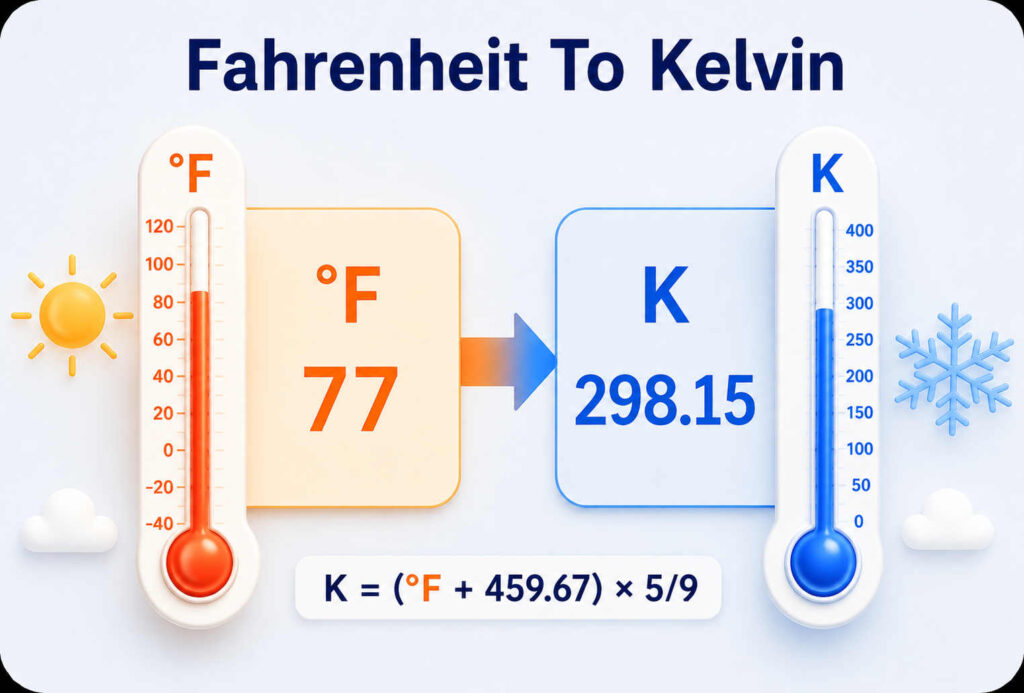
Fahrenheit Reference Points
| Description | Fahrenheit |
|---|---|
| Absolute zero | -459.67°F |
| Water freezing point | 32°F |
| Cool weather | 50°F |
| Room temperature | 68-72°F |
| Human body temperature | 98.6°F |
| Water boiling point | 212°F |
Fahrenheit is still widely used for:
- Weather forecasts
- Household temperature settings
- Cooking temperatures
- Body temperature readings
Kelvin (K)
Kelvin is the standard temperature unit used in scientific measurement. Unlike Celsius and Fahrenheit, Kelvin is an absolute temperature scale, meaning it starts from absolute zero.
Absolute zero is the theoretical point where molecular motion reaches its minimum possible level.
Kelvin does not use the degree symbol. The correct format is:
- 300 K
- Not 300°K
The size of one Kelvin unit is the same as one Celsius degree, but the starting point is different.
The relationship is:
- 0 K = -273.15°C
- 273.15 K = 0°C
Kelvin Reference Points
| Description | Kelvin |
|---|---|
| Absolute zero | 0 K |
| Water freezing point | 273.15 K |
| Room temperature | Around 293-295 K |
| Human body temperature | About 310 K |
| Water boiling point | 373.15 K |
Kelvin is commonly used in:
- Physics
- Chemistry
- Astronomy
- Thermodynamics
- Engineering calculations
Rankine (°R)
Rankine is another absolute temperature scale. It is similar to Kelvin, but instead of using Celsius-sized degrees, Rankine uses Fahrenheit-sized degrees.
Rankine starts at absolute zero:
- 0°R = absolute zero
Because Rankine uses Fahrenheit increments, it is mainly used in engineering fields where Fahrenheit-based calculations are common.
Rankine is often found in:
- Thermodynamics
- Aerospace engineering
- Heat transfer calculations
- Mechanical engineering
Rankine Reference Points
| Description | Rankine |
|---|---|
| Absolute zero | 0°R |
| Water freezing point | 491.67°R |
| Room temperature | About 527°R |
| Water boiling point | 671.67°R |
Although Rankine is less common in everyday life, it remains useful in specialized engineering applications.
Temperature Scale Comparison
The four major temperature scales can be compared as follows:
| Scale | Symbol | Absolute Zero | Water Freezing | Water Boiling |
|---|---|---|---|---|
| Celsius | °C | -273.15 | 0 | 100 |
| Fahrenheit | °F | -459.67 | 32 | 212 |
| Kelvin | K | 0 | 273.15 | 373.15 |
| Rankine | °R | 0 | 491.67 | 671.67 |
Celsius and Fahrenheit are relative temperature scales used mainly in everyday applications.
Kelvin and Rankine are absolute temperature scales used when temperature calculations involve physical laws and energy relationships.
Temperature Conversion Formulas
Temperature conversion requires different formulas because each scale uses different reference points.
Fahrenheit to Celsius
To convert Fahrenheit to Celsius:
Celsius = (Fahrenheit – 32) × 5/9
Example:
Convert 68°F to Celsius:
68 – 32 = 36
36 × 5/9 = 20
Therefore:
68°F = 20°C
Celsius to Fahrenheit
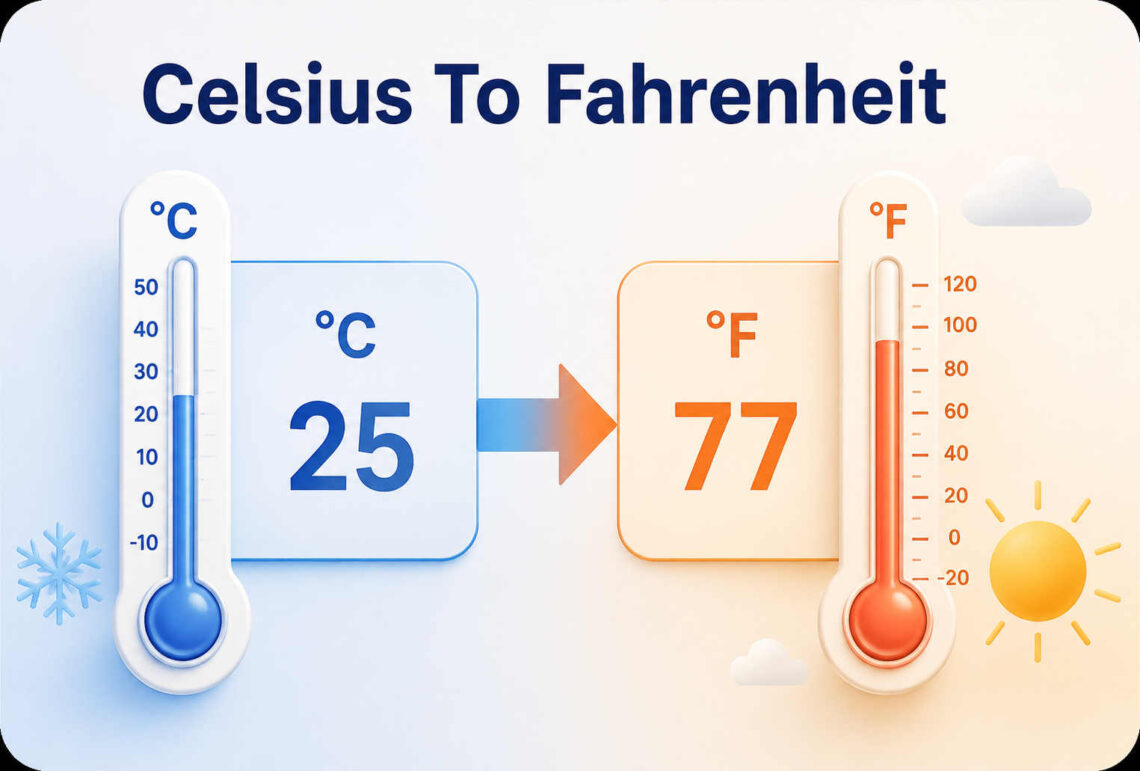
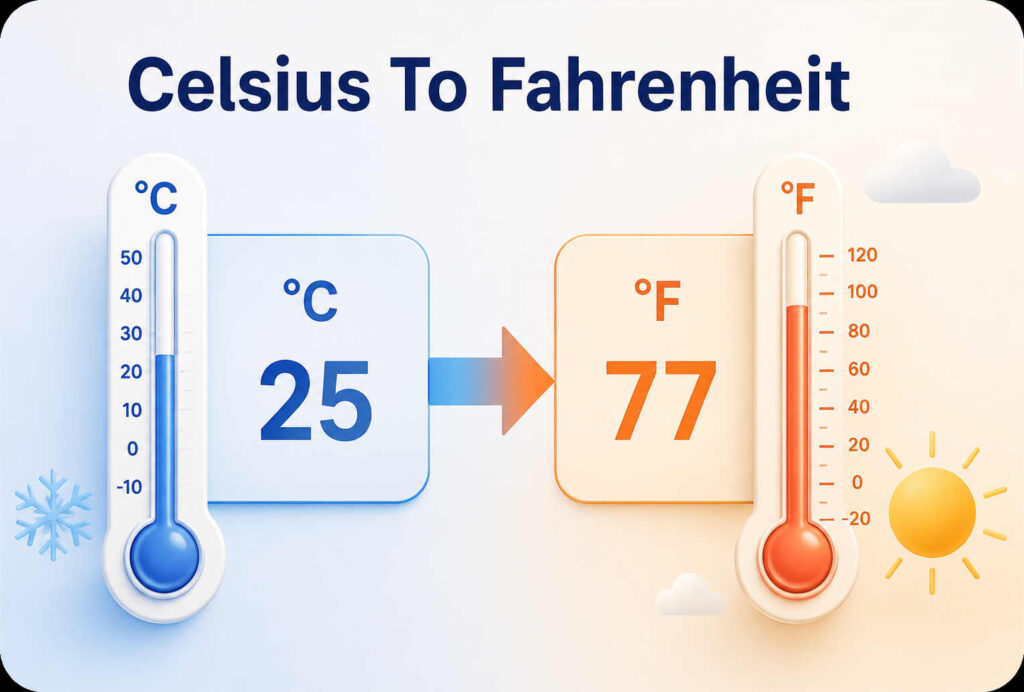
To convert Celsius to Fahrenheit:
Fahrenheit = Celsius × 9/5 + 32
Example:
Convert 25°C:
25 × 9/5 + 32
= 45 + 32
= 77°F
Therefore:
25°C = 77°F
Celsius to Kelvin
Kelvin conversion is simple:
Kelvin = Celsius + 273.15
Example:
20°C:
20 + 273.15
= 293.15 K
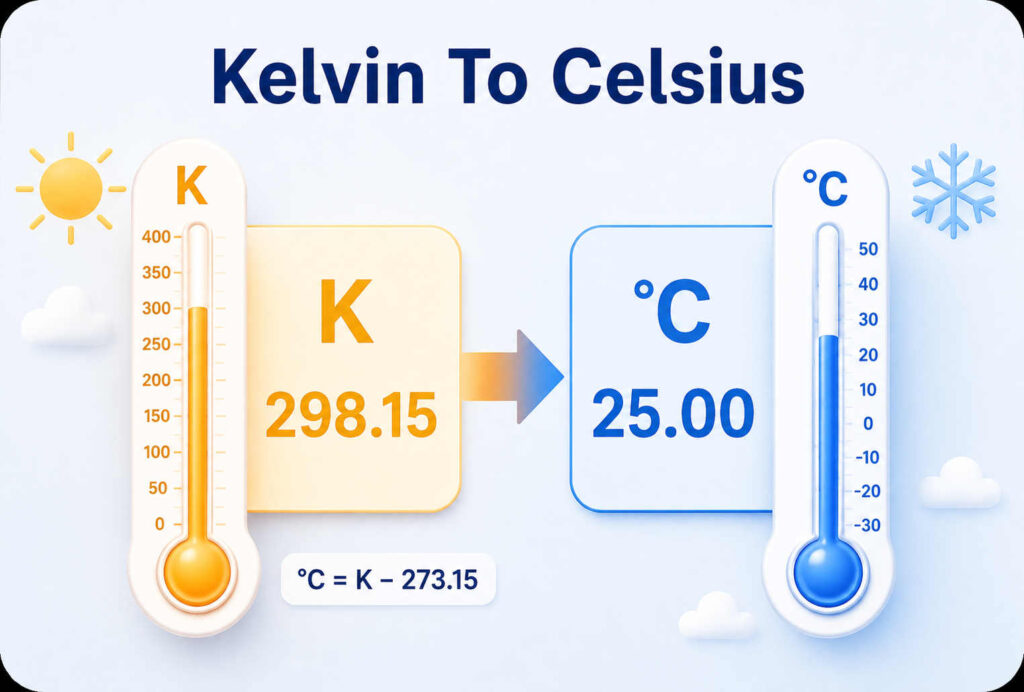
Kelvin to Celsius
The reverse conversion:
Celsius = Kelvin – 273.15
Example:
300 K:
300 – 273.15
= 26.85°C
Fahrenheit to Rankine
Because Rankine uses the Fahrenheit degree size:
Rankine = Fahrenheit + 459.67
Example:
32°F:
32 + 459.67
= 491.67°R
Rankine to Fahrenheit
The reverse formula:
Fahrenheit = Rankine – 459.67
Example:
671.67°R:
671.67 – 459.67
= 212°F
Kelvin to Rankine
The conversion between Kelvin and Rankine is based on their degree size difference:
Rankine = Kelvin × 9/5
Example:
300 K:
300 × 9/5
= 540°R
Rankine to Kelvin
Reverse conversion:
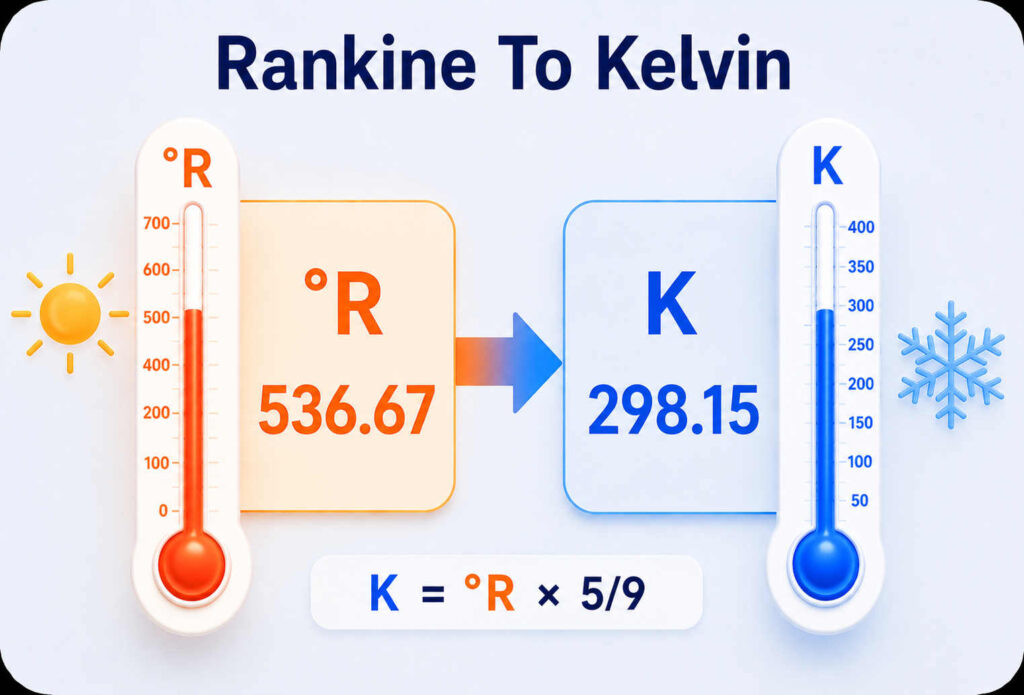
Kelvin = Rankine × 5/9
Example:
540°R:
540 × 5/9
= 300 K
Temperature Conversion Chart
| Celsius | Fahrenheit | Kelvin | Rankine |
|---|---|---|---|
| -273.15 | -459.67 | 0 | 0 |
| -40 | -40 | 233.15 | 419.67 |
| 0 | 32 | 273.15 | 491.67 |
| 10 | 50 | 283.15 | 509.67 |
| 20 | 68 | 293.15 | 527.67 |
| 25 | 77 | 298.15 | 536.67 |
| 30 | 86 | 303.15 | 545.67 |
| 37 | 98.6 | 310.15 | 558.27 |
| 100 | 212 | 373.15 | 671.67 |
Common Temperature Conversions
Weather Temperature
Different countries use different temperature scales for weather reporting.
Examples:
| Weather Description | Fahrenheit | Celsius |
|---|---|---|
| Freezing weather | 32°F | 0°C |
| Cool day | 50°F | 10°C |
| Comfortable weather | 68°F | 20°C |
| Warm day | 86°F | 30°C |
| Very hot day | 104°F | 40°C |
Cooking Temperature Conversion
Cooking instructions often use Fahrenheit, especially in recipes from the United States.
Common oven temperatures:
| Fahrenheit | Celsius |
|---|---|
| 300°F | 149°C |
| 325°F | 163°C |
| 350°F | 177°C |
| 375°F | 191°C |
| 400°F | 204°C |
| 450°F | 232°C |
Human Body Temperature
Body temperature is commonly measured in Celsius or Fahrenheit.
| Condition | Fahrenheit | Celsius |
|---|---|---|
| Normal | 98.6°F | 37°C |
| Mild fever | 100.4°F | 38°C |
| High fever | 104°F | 40°C |
Why Are There Different Temperature Scales?
Different temperature scales developed for different historical and scientific reasons.
Celsius became popular because it fits naturally with the metric system and water-based reference points.
Fahrenheit became widely used in some regions because of historical adoption and existing measurement systems.
Kelvin was created for scientific calculations because absolute zero provides a universal starting point.
Rankine was developed for engineering applications where Fahrenheit-based calculations were already common.
Today, all four scales continue to be used depending on the situation.
Frequently Asked Questions
How do you convert Fahrenheit to Celsius?
Subtract 32 from the Fahrenheit value, then multiply by 5/9.
Example:
100°F = (100 – 32) × 5/9 = 37.78°C
What is 100 Fahrenheit in Celsius?
100°F equals approximately 37.78°C.
Is Celsius the same as Fahrenheit?
No. Celsius and Fahrenheit measure the same physical temperature but use different numerical scales.
What temperature is 0 Fahrenheit?
0°F equals approximately -17.78°C.
What is Rankine temperature?
Rankine is an absolute temperature scale based on Fahrenheit degrees. It starts at absolute zero.
What is the difference between Kelvin and Rankine?
Kelvin uses Celsius-sized degrees, while Rankine uses Fahrenheit-sized degrees. Both begin at absolute zero.
Related Temperature Conversion Tools
Temperature conversion tools can help quickly convert between:
- Fahrenheit to Celsius
- Celsius to Fahrenheit
- Celsius to Kelvin
- Kelvin to Celsius
- Fahrenheit to Rankine
- Rankine to Fahrenheit
- Kelvin to Rankine
Whether you are converting weather temperatures, cooking settings, scientific measurements, or engineering values, understanding the relationship between temperature scales makes conversions easier and more accurate.