
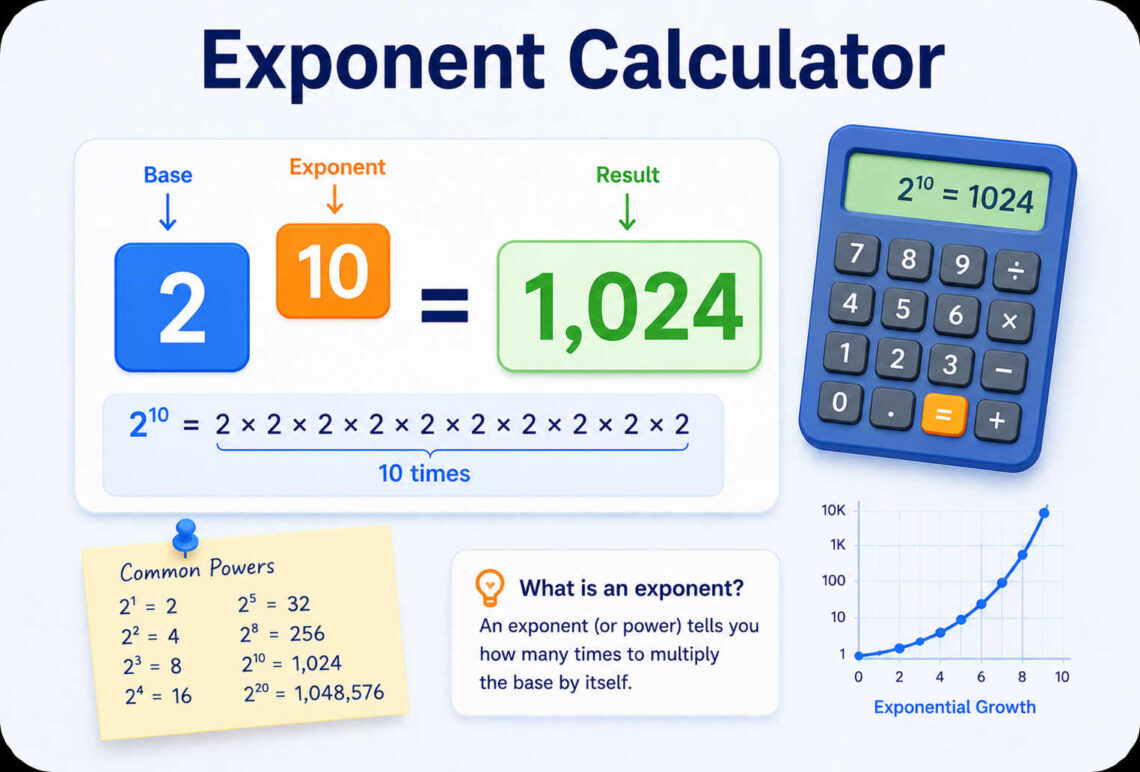
Quick Answer: What is 4 to the Power of 3?
4 to the power of 3 equals 64.
In mathematical notation, this is written as:
4³ = 64
The expression 4 to the power of 3 means that the number 4 is used as a factor three times:
4 × 4 × 4 = 64
A common mistake is to multiply 4 by 3 and get 12. However, exponents do not work like ordinary multiplication. The small number written above the base number is called an exponent, and it tells us how many times the base appears in a multiplication expression.
Once you understand how powers work, expressions like 4³, 5², or 10⁴ become much easier to calculate.
What Does “4 to the Power of 3” Mean?
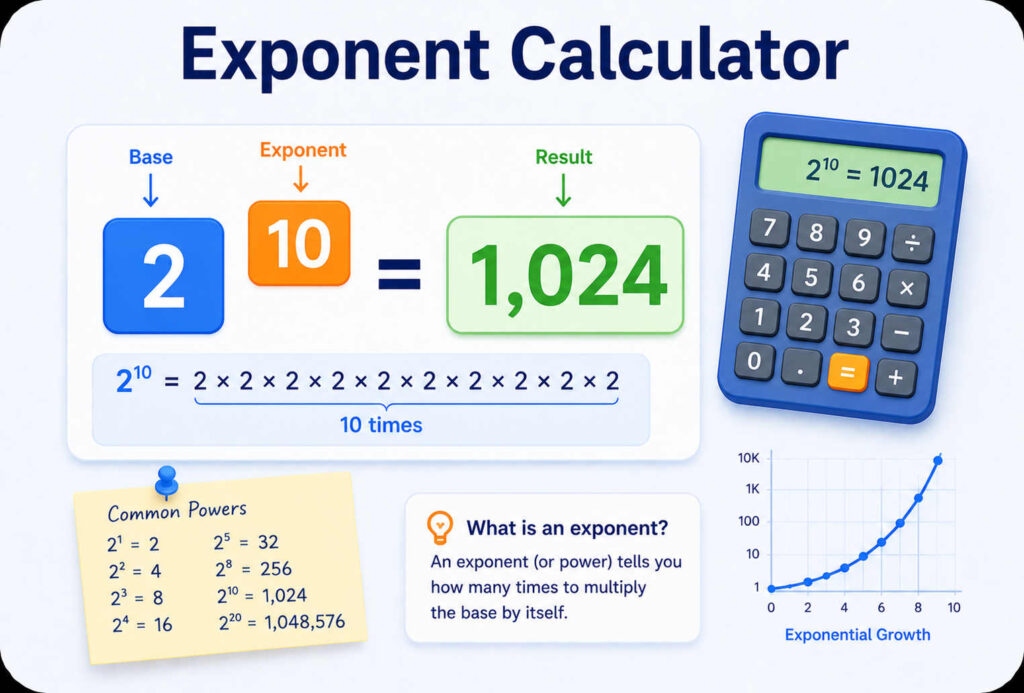
When we write 4³, we are using exponential notation.
Every exponential expression has two main parts:
- Base: the number being multiplied
- Exponent (or power): the number of times the base appears as a factor
For 4³:
- Base = 4
- Exponent = 3
The exponent does not mean “multiply 4 by 3.”
Instead, it means:
“Use 4 as a factor three times.”
So:
4³ = 4 × 4 × 4
Now calculate:
Step 1:
4 × 4 = 16
Step 2:
16 × 4 = 64
Therefore:
4³ = 64
How to Calculate 4³ Step by Step
You can calculate 4 to the power of 3 manually.
Step 1: Start with the base number
The base number is:
4
Step 2: Multiply the base by itself
4 × 4 = 16
This gives us:
4² = 16
Step 3: Multiply by the base one more time
16 × 4 = 64
Therefore:
4³ = 64
This calculation shows an important idea about exponents:
Each time the exponent increases by 1, the previous answer is multiplied by the base.
For example:
4¹ = 4
4² = 4 × 4 = 16
4³ = 16 × 4 = 64
4⁴ = 64 × 4 = 256
A Faster Mental Math Method for 4³
If you already know some basic powers, there is a shortcut.
Because:
4² = 16
You can calculate:
4³ = 4² × 4
Then:
16 × 4 = 64
This method is useful because many exponent problems can be solved by breaking them into smaller known powers.
For example:
4⁵
can be written as:
4² × 4³
= 16 × 64
= 1024
Understanding smaller powers helps you calculate larger ones quickly.
Why Is 4³ Not Equal to 12?
This is the most common misunderstanding when learning exponents.
Some people see:
4³
and think:
4 × 3 = 12
But this is incorrect.
The difference is:
Multiplication
4 × 3 means:
Add four three times:
4 + 4 + 4 = 12
Exponentiation
4³ means:
Multiply four by itself three times:
4 × 4 × 4 = 64
An exponent describes repeated multiplication, not repeated addition.
This difference is one of the most important concepts in early algebra.
Visual Explanation of 4³
Another way to understand 4³ is through geometry.
The second power creates a square.
The third power creates a cube.
4²
A square with:
4 rows
and
4 columns
contains:
4 × 4 = 16 squares
4³
A cube with:
length = 4
width = 4
height = 4
contains:
4 × 4 × 4 = 64 small cubes
This is why the third power is often called “cubed.”
For example:
- 2³ = two cubed
- 3³ = three cubed
- 4³ = four cubed
Powers of 4 Table
Understanding the pattern of powers makes exponent calculations easier.
| Expression | Expanded Form | Result |
|---|---|---|
| 4¹ | 4 | 4 |
| 4² | 4 × 4 | 16 |
| 4³ | 4 × 4 × 4 | 64 |
| 4⁴ | 4 × 4 × 4 × 4 | 256 |
| 4⁵ | 4 × 4 × 4 × 4 × 4 | 1024 |
| 4⁶ | 4 × 4 × 4 × 4 × 4 × 4 | 4096 |
Notice the pattern:
Every new power is multiplied by 4.
Comparing 4³ With Other Numbers
The value of a power depends on both the base and exponent.
Compare:
3³
3 × 3 × 3
= 27
4³
4 × 4 × 4
= 64
5³
5 × 5 × 5
= 125
Increasing the base by only 1 creates a much larger result because exponential growth happens quickly.
4³ vs 3⁴: Which Is Bigger?
These two expressions are often confused.
They contain the same numbers:
4 and 3
but the positions are different.
4³
= 4 × 4 × 4
= 64
3⁴
= 3 × 3 × 3 × 3
= 81
Therefore:
3⁴ is larger than 4³
This shows that the base and exponent cannot be swapped.
The first number is always the base.
Real-Life Applications of 4³
Although powers may look like abstract math, they appear in many practical situations.
1. Volume and 3D Measurements
If a cube has sides measuring 4 units:
Volume:
4 × 4 × 4
= 64 cubic units
This appears in:
- architecture
- engineering
- manufacturing
- 3D design
2. Computer Science and Data Structures
Computer science frequently uses exponential calculations.
For example:
If a program has:
4 possible choices
at each of:
3 different steps
The total possible combinations are:
4³ = 64
This type of calculation appears in:
- algorithms
- search problems
- game development
- programming logic
3. Probability Problems
Imagine a situation where each decision has 4 possible outcomes.
If you make 3 independent decisions:
Total possibilities:
4 × 4 × 4
= 64
This is why exponents are common in probability.
4. Growth and Repeated Multiplication
If something becomes four times larger repeatedly, powers naturally appear.
Starting value:
1
After 3 rounds of quadrupling:
1 × 4³
= 64
This idea is used in:
- population models
- financial projections
- scientific simulations
Exponent Rules Related to 4³
Understanding exponent rules allows you to solve more complicated expressions.
Rule 1: Multiplying Same Bases
When multiplying powers with the same base, add exponents.
Example:
4² × 4¹
= 4³
= 64
Rule 2: Dividing Same Bases
When dividing powers with the same base, subtract exponents.
Example:
4⁵ ÷ 4²
= 4³
= 64
Rule 3: Power of a Power
When raising a power to another power, multiply exponents.
Example:
(4²)³
= 4⁶
Rule 4: Zero Exponent
Any non-zero number raised to the power of zero equals 1.
Example:
4⁰ = 1
Rule 5: Negative Exponent
A negative exponent means the reciprocal.
Example:
4⁻³
= 1 / 4³
= 1 / 64
Common Mistakes When Calculating 4³
Mistake 1: Multiplying Base and Exponent
Incorrect:
4 × 3 = 12
Correct:
4³ = 64
Mistake 2: Adding Instead of Multiplying
Incorrect:
4 + 4 + 4 = 12
Correct:
4 × 4 × 4 = 64
Mistake 3: Confusing 4³ and 3⁴
Remember:
The base comes first.
4³ = 64
3⁴ = 81
Mistake 4: Forgetting the Number of Factors
4³ has three 4s:
4 × 4 × 4
Not:
4 × 4
and not:
4 × 4 × 4 × 4
Practice Problems
Try solving these:
- What is 2³?
- What is 6³?
- What is 4⁴?
- If 4² = 16, what is 4³?
- What is the cube root of 64?
Answers:
- 2³ = 8
- 6³ = 216
- 4⁴ = 256
- 4³ = 64
- Cube root of 64 = 4
Frequently Asked Questions
What is 4 to the 3rd power?
4 to the 3rd power equals:
64
because:
4 × 4 × 4 = 64
How do you write 4 to the power of 3?
You can write it as:
- 4³
- 4^3
- four cubed
- four to the third power
Is 64 a perfect cube?
Yes.
Because:
4³ = 64
64 is a perfect cube.
What is the cube root of 64?
The cube root of 64 is:
4
because:
4 × 4 × 4 = 64
Is 4³ bigger than 3³?
Yes.
4³ = 64
3³ = 27
So 4³ is larger.
Summary
4 to the power of 3 equals 64.
The calculation is:
4³ = 4 × 4 × 4 = 64
The key idea is that the exponent tells you how many times the base appears as a factor.
Remember:
- 4 is the base
- 3 is the exponent
- 64 is the result
Learning how powers work builds the foundation for algebra, geometry, programming, probability, and many scientific calculations.