
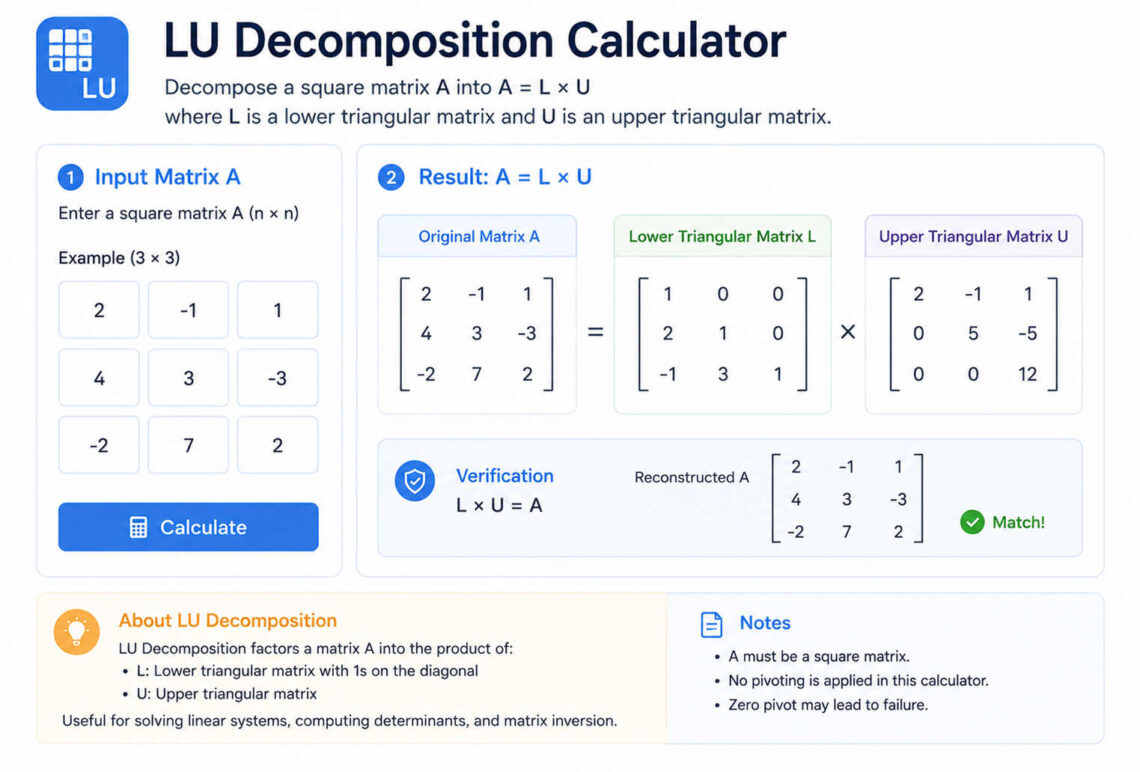
A LU Decomposition Calculator is an online mathematical tool used to
factor a square matrix into two simpler matrices: a Lower Triangular Matrix (L)
and an Upper Triangular Matrix (U).
LU decomposition, also known as LU factorization, is one of the most important methods
in linear algebra and numerical computing. It helps transform complicated matrix problems
into simpler calculations that computers can solve efficiently.
Although LU decomposition is often introduced as a theoretical topic in mathematics,
it has many practical applications in engineering, computer science, physics, finance,
data analysis, and scientific simulation. Many technologies used today rely on numerical
methods based on matrix decomposition.
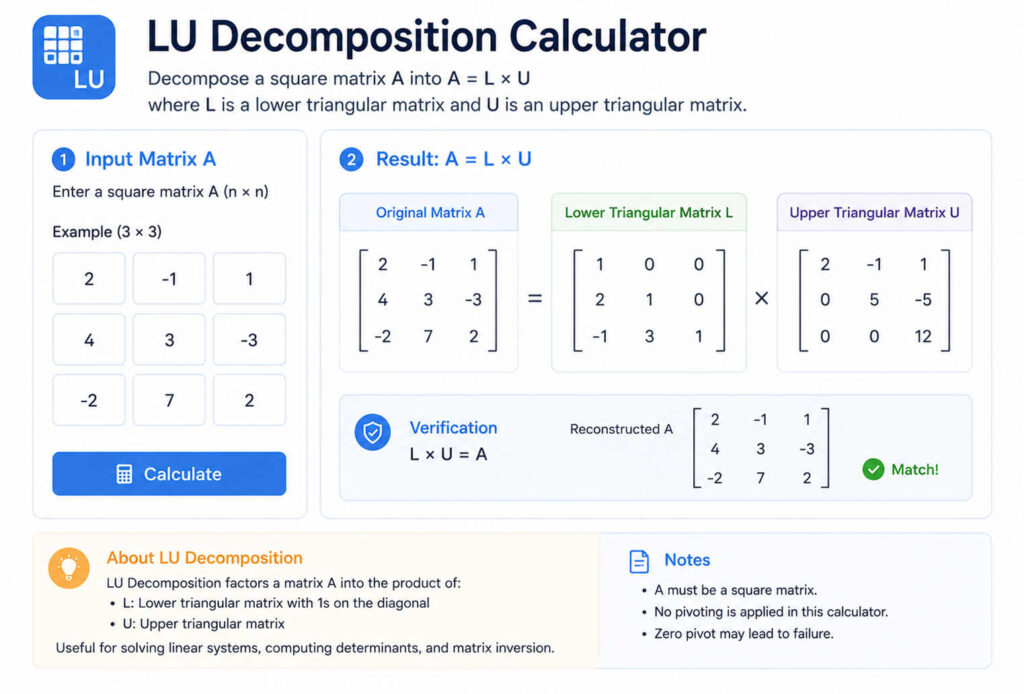
What Is LU Decomposition?
LU decomposition is a matrix factorization method that separates a matrix into two parts:
A = LU
where:
- A is the original square matrix
- L is the lower triangular matrix
- U is the upper triangular matrix
A lower triangular matrix is a matrix where all elements above the main diagonal are zero.
For example:
1  0  0
2  1  0
3  4  1
An upper triangular matrix is a matrix where all elements below the main diagonal are zero.
5  2  1
0  3  4
0  0  6
The purpose of LU decomposition is to rewrite a difficult matrix problem into two
simpler triangular matrix problems.
Why Is LU Decomposition Important?
Many scientific and engineering problems can be represented as systems of linear equations:
Ax = b
For small systems, humans can solve equations manually. However, real-world problems
often contain thousands or millions of unknown variables.
Examples include:
- Structural engineering simulations
- Electrical circuit analysis
- Weather forecasting
- Machine learning models
- Financial calculations
Directly solving these large systems can be slow. LU decomposition improves efficiency
by converting the original problem into:
LUx = b
which can be solved in two easier steps:
- Solve Ly = b
- Solve Ux = y
Because triangular matrices are easier to solve, LU decomposition reduces computational
complexity.
How Does an LU Decomposition Calculator Work?
A LU Decomposition Calculator automates the process of matrix factorization.
Instead of manually performing many elimination steps, users can enter a matrix and
instantly obtain the corresponding L and U matrices.
Step 1: Enter the Matrix
Users enter a square matrix into the calculator.
2  3  1
4  7  2
6 18  5
Step 2: Perform Matrix Factorization
The calculator applies an LU decomposition algorithm, such as the Doolittle method
or Crout method, to separate the matrix into two components.
Step 3: Generate the Lower Matrix (L)
The calculator produces the lower triangular matrix containing the elimination factors.
1 0 0
2 1 0
3 9 1
Step 4: Generate the Upper Matrix (U)
The upper triangular matrix contains the simplified result after elimination.
2 3 1
0 1 0
0 0 2
Step 5: Verify the Result
A correct decomposition satisfies:
L × U = A
LU Decomposition and Gaussian Elimination
LU decomposition is closely related to Gaussian elimination.
Gaussian elimination transforms a matrix into an upper triangular matrix by removing
values below the diagonal.
LU decomposition stores the elimination process itself.
In simple terms:
- Gaussian elimination creates U
- LU decomposition records the steps in L and creates U
This makes LU decomposition useful when the same matrix needs to be solved multiple
times with different values of b.
Solving Linear Equations with LU Decomposition
One of the main uses of LU decomposition is solving systems of linear equations.
Suppose:
Ax = b
After decomposition:
LUx = b
The equation becomes:
Ly = b
and:
Ux = y
The first step is called forward substitution, while the second step is called
back substitution.
This method is faster than solving the original system repeatedly.
Real-World Applications of LU Decomposition
LU decomposition is widely used in modern technology. Although most people do not
directly interact with it, many computer systems rely on matrix solving techniques
based on LU factorization.
1. Structural Engineering and Building Design
Engineers use LU decomposition in structural analysis to simulate how objects behave
under different forces.
A building, bridge, aircraft, or machine can be divided into thousands or millions
of smaller elements. Each element creates mathematical relationships that form a large
system of equations.
Kx = f
- K represents the stiffness matrix
- x represents unknown deformation
- f represents external forces
LU decomposition helps engineers calculate:
- How much a bridge bends
- How a building reacts during an earthquake
- Whether an aircraft structure is safe
- Where mechanical stress occurs
2. Electrical Circuit Simulation
Electronic devices contain extremely complex circuits. Engineers convert circuit
relationships into mathematical systems.
Ax = b
LU decomposition helps calculate:
- Voltage at different points
- Current through components
- Power consumption
- Circuit behavior under different conditions
Circuit simulation software used for designing computers, smartphones, and vehicles
depends on efficient matrix-solving methods.
3. Computer Graphics and 3D Simulation
3D graphics rely heavily on matrix operations.
Modern games and simulations use mathematical models for:
- Object movement
- Camera positioning
- Physics calculations
- Collision detection
Large numbers of objects interacting in real time create complex systems that require
fast numerical algorithms.
4. Weather Forecasting and Climate Modeling
Weather prediction is based on solving large mathematical models.
The atmosphere is divided into millions of small regions. Each region contains values
such as:
- Temperature
- Pressure
- Wind speed
- Humidity
Supercomputers repeatedly solve these equations to predict future weather patterns.
LU-based methods help improve computational efficiency.
5. GPS and Navigation Systems
GPS receivers determine location by solving equations involving satellite signals.
The system must process:
- Satellite positions
- Signal travel time
- Distance measurements
- Timing errors
These calculations become matrix problems that can be solved using numerical methods
such as LU decomposition.
6. Machine Learning and Artificial Intelligence
Artificial intelligence systems process large amounts of numerical data.
Many machine learning methods involve matrix calculations.
Applications include:
- Linear regression
- Optimization algorithms
- Statistical modeling
- Data analysis
LU decomposition can help solve matrix equations efficiently without directly computing
large matrix inverses.
7. Finance and Economic Modeling
Financial institutions use mathematical models to study markets and risks.
Large financial systems may include:
- Asset relationships
- Interest rates
- Investment risks
- Market predictions
LU decomposition helps solve these large systems and supports:
- Portfolio optimization
- Risk analysis
- Financial forecasting
Types of LU Decomposition
Doolittle Method
The Doolittle method is one of the most commonly used LU decomposition techniques.
The diagonal elements of L are usually set to 1.
Crout Method
The Crout method uses a different arrangement where the diagonal elements of U are
often set to 1.
Cholesky Decomposition
Cholesky decomposition is a special case used for symmetric positive definite matrices.
It has applications in statistics, optimization, and numerical simulations.
Limitations of LU Decomposition
Requires Square Matrices
Traditional LU decomposition works mainly with square matrices.
Numerical Stability Issues
Some matrices require row exchanges to avoid calculation errors.
This leads to:
PA = LU
where P is a permutation matrix.
Large Memory Requirements
Very large matrices may require significant computing resources.
Modern systems often use optimized methods such as sparse LU decomposition.
LU Decomposition Calculator FAQ
Is LU decomposition the same as matrix multiplication?
No. Matrix multiplication combines matrices, while LU decomposition separates a matrix
into simpler components.
Can LU decomposition calculate a matrix inverse?
Yes. Many numerical algorithms use LU decomposition to calculate inverses more efficiently.
Who uses LU decomposition?
Students, engineers, programmers, researchers, and scientists use LU decomposition
for solving mathematical and computational problems.
Conclusion
A LU Decomposition Calculator is a powerful tool for understanding and performing
matrix factorization. It converts complex matrices into simpler lower and upper
triangular matrices, making difficult calculations faster and easier.
Beyond mathematics classrooms, LU decomposition supports many real-world technologies,
including engineering simulation, electronic design, navigation systems, artificial
intelligence, weather forecasting, and financial analysis.
Although LU decomposition operates behind the scenes, it is one of the important
numerical techniques that helps modern computers solve large-scale problems efficiently.