
What Is a Fibonacci Numbers Calculator?
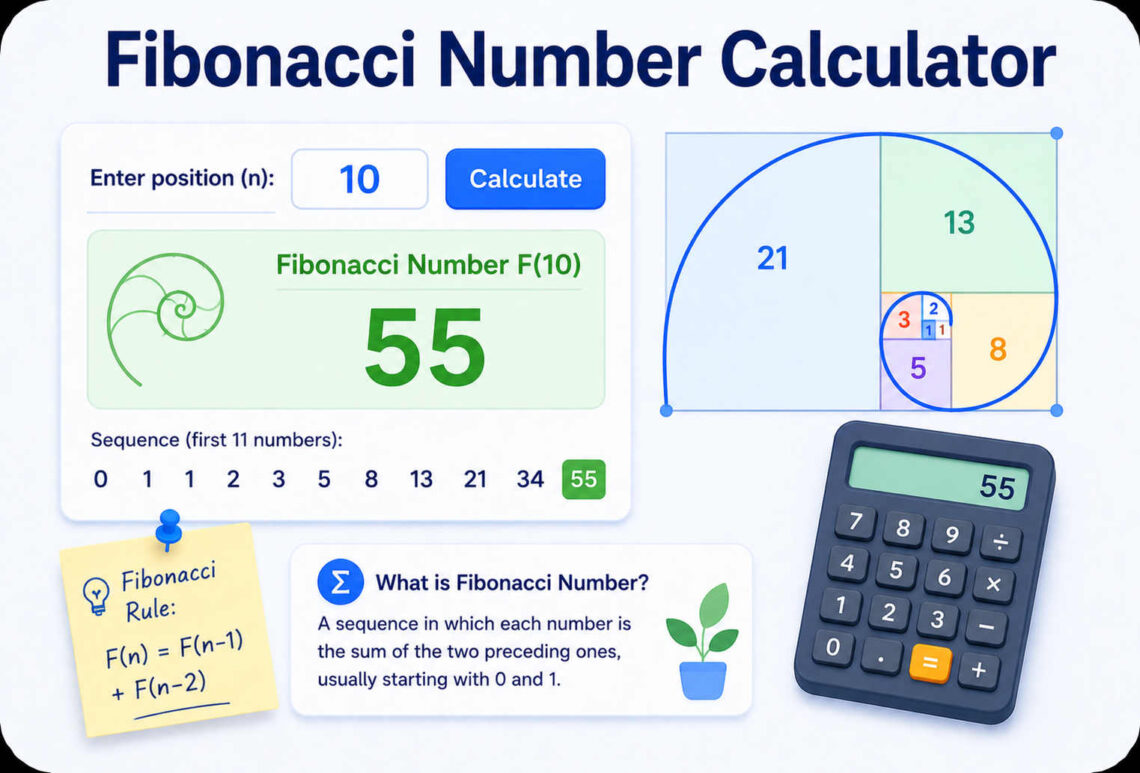
A Fibonacci Numbers Calculator is an online mathematical tool used to calculate values from the Fibonacci sequence. Instead of manually adding numbers one by one, users can enter a position number (n), and the calculator instantly returns the corresponding Fibonacci number.
For example, if you enter:
N = 10
the calculator returns:
55
because the 10th Fibonacci number is 55 (depending on the indexing method used).
Many Fibonacci calculators can also generate multiple terms of the sequence, such as the first 100 or 200 Fibonacci numbers. Some advanced versions allow users to customize the starting values and create their own Fibonacci-like sequences.
This tool is useful for students, programmers, mathematicians, engineers, and anyone who wants to explore one of the most famous sequences in mathematics.
What Is the Fibonacci Sequence?
The Fibonacci sequence is a series of numbers where each number is created by adding the two previous numbers.
The traditional Fibonacci sequence starts with:
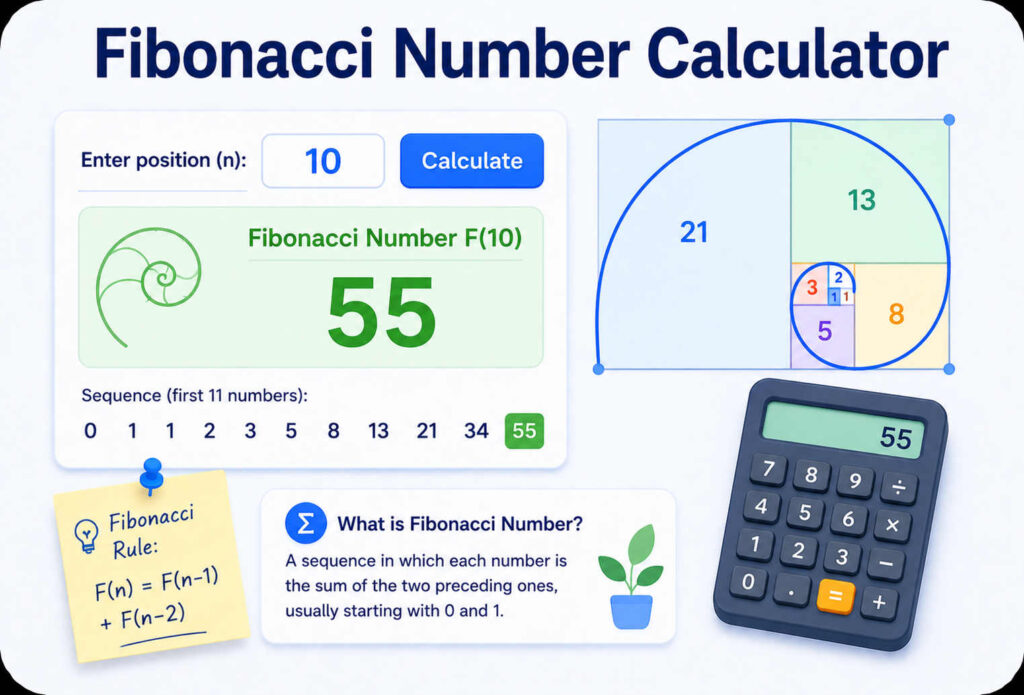
0, 1, 1, 2, 3, 5, 8, 13, 21, 34, 55, 89...The rule is:
Each term equals the sum of the two terms before it.
For example:
- 0 and 1 are the starting values
- 0 + 1 = 1
- 1 + 1 = 2
- 1 + 2 = 3
- 2 + 3 = 5
- 3 + 5 = 8
So the sequence continues forever.
Mathematically, the Fibonacci sequence is usually represented as:
F(n) = F(n-1) + F(n-2)
where:
- F(n) is the current Fibonacci number
- F(n-1) is the previous Fibonacci number
- F(n-2) is the number before that
The Fibonacci Numbers Calculator simply automates this calculation process.
What Does a Fibonacci Numbers Calculator Do?
The main purpose of a Fibonacci calculator is to quickly find Fibonacci numbers without requiring manual calculations.
A typical Fibonacci calculator works like this:
- The user enters a number, such as 20
- The calculator identifies the requested position
- The program calculates the Fibonacci sequence
- The result is displayed immediately
For example:
Input:
N = 8Output:
21because:
F(8) = 21Some calculators also show the complete sequence:
0, 1, 1, 2, 3, 5, 8, 13, 21This makes it easier to understand how the sequence develops.
Why Use a Fibonacci Calculator Instead of Doing It Manually?
For small numbers, Fibonacci calculations are easy.
For example:
F(5)

0, 1, 1, 2, 3, 5
However, Fibonacci numbers grow extremely quickly.
For example:
F(20) = 6765

F(50) = 12586269025

F(100) = 354224848179261915075
Manually calculating large Fibonacci numbers becomes impractical.
A calculator can:
- instantly compute large terms
- avoid calculation mistakes
- display long sequences
- help verify programming results
- support mathematical learning
This makes it valuable for both beginners and professionals.
Common Uses of a Fibonacci Numbers Calculator
1. Learning Mathematics
One of the most common uses of a Fibonacci calculator is education.
Students use it to understand:
- sequences
- recursion
- mathematical patterns
- number relationships
- growth models
Teachers often introduce Fibonacci numbers because they are simple to explain but lead to deeper mathematical concepts.
A calculator allows students to experiment:
“What happens at the 30th term?”
“How quickly does the sequence grow?”
“Does the pattern continue?”
Instead of spending time calculating, students can focus on understanding the concept.
2. Programming and Algorithm Practice
Fibonacci numbers are among the most famous examples in computer science.
Many beginner programming courses use Fibonacci sequences to teach:
- loops
- recursion
- functions
- arrays
- dynamic programming
A simple programming exercise might ask:
“Write a program that prints the first 100 Fibonacci numbers.”
The basic recursive approach looks like:
F(n) = F(n-1) + F(n-2)However, this approach can become slow because it repeats calculations.
For example:
To calculate:
F(10)a simple recursive program calculates:
F(9) + F(8)then:
F(8) + F(7)and many values are calculated again.
Programmers improve this using:
Dynamic Programming
Instead of recalculating old values, the program stores previous results.
This makes Fibonacci calculation much faster.
Because of this, Fibonacci is a classic example in algorithm discussions.
3. Technical Interviews and Coding Tests
Fibonacci problems frequently appear in software engineering interviews.
Interviewers may ask:
“How would you calculate the nth Fibonacci number efficiently?”
They want to test whether a candidate understands:
- recursion
- optimization
- memory usage
- computational complexity
A basic recursive solution may have poor performance.
An optimized solution can calculate the result much faster.
For example:
Recursive approach:
- easy to understand
- but inefficient for large n
Iterative approach:
- faster
- uses less memory
Dynamic programming approach:
- stores previous calculations
- improves efficiency
Therefore, Fibonacci is not only a mathematical sequence but also a practical programming challenge.
4. Exploring the Golden Ratio
One of the most famous properties of Fibonacci numbers is their connection to the golden ratio.
The golden ratio is approximately:
1.618033988...As Fibonacci numbers become larger, the ratio between consecutive Fibonacci numbers approaches the golden ratio.
For example:
13 / 8 = 1.625

21 / 13 = 1.615

34 / 21 = 1.619
The numbers get closer and closer to 1.618.
This relationship has fascinated mathematicians for centuries.
The golden ratio appears in:
- geometry
- architecture
- design
- art
- natural patterns
5. Nature and Fibonacci Patterns
Fibonacci numbers are often associated with patterns found in nature.
Examples include:
Sunflowers
The arrangement of sunflower seeds often follows spiral patterns related to Fibonacci numbers.
This arrangement helps maximize space efficiency.
Pinecones
The spiral patterns on pinecones frequently match Fibonacci numbers.
Leaves and Plants
Many plants grow leaves in patterns that follow Fibonacci-related arrangements.
This helps plants optimize:
- sunlight exposure
- space usage
- growth efficiency
However, not every natural pattern is exactly Fibonacci. The relationship is interesting but sometimes simplified in popular explanations.
6. Fibonacci in Financial Analysis
Fibonacci numbers are also used in financial markets.
A popular concept is:
Fibonacci Retracement
Traders use Fibonacci-derived percentages such as:
- 23.6%
- 38.2%
- 50%
- 61.8%
to analyze possible price movements.
These levels are based on mathematical relationships related to Fibonacci numbers and the golden ratio.
A Fibonacci Numbers Calculator itself does not predict stock prices, but it helps calculate the underlying numbers used in these tools.
Why Do Many Fibonacci Calculators Limit Input Between 0 and 99?
Many online Fibonacci calculators allow users to enter numbers like:
0 to 99This limitation exists because Fibonacci numbers grow extremely fast.
For example:
F(10) = 55

F(20) = 6765

F(50) = 12586269025

F(100) = 354224848179261915075
The numbers quickly become extremely large.
Many programming environments have limits on how accurately they can store large numbers.
For example, JavaScript’s standard number type uses floating-point representation, which cannot safely represent unlimited integers.
After a certain point, calculations may lose precision.
Therefore, many web calculators limit the input range to avoid incorrect results.
Some advanced calculators use special methods such as:
- Big Integer calculations
- arbitrary precision libraries
- custom mathematical algorithms
to handle larger Fibonacci numbers.
Custom Fibonacci Sequences
Some Fibonacci calculators allow users to change the starting values.
The traditional Fibonacci sequence:
0, 1, 1, 2, 3, 5...starts with:
F(0)=0
F(1)=1
But you can create other sequences.
For example:
Starting values:
2, 3The sequence becomes:
2, 3, 5, 8, 13, 21...The same addition rule applies:
current = previous + previous previousThese customized sequences are sometimes called:
- Fibonacci-like sequences
- generalized Fibonacci sequences
They are useful in mathematics and algorithm studies.
How a Fibonacci Calculator Works Behind the Scenes
A simple Fibonacci calculator can use a loop.
The logic is:
- Store the first two numbers
- Add them together
- Save the result
- Repeat until reaching the requested position
Example:
previous = 0
current = 1

next = previous + current
Then update:
previous = current
current = next
This continues until the desired Fibonacci number is found.
Modern calculators may use faster mathematical methods such as:
- matrix exponentiation
- fast doubling algorithms
These methods can calculate very large Fibonacci numbers much faster.
Fibonacci Numbers Calculator Summary
A Fibonacci Numbers Calculator is a simple but powerful mathematical tool that helps users calculate Fibonacci sequence values quickly.
It is mainly used for:
- learning number sequences
- studying mathematical patterns
- practicing programming
- preparing for coding interviews
- exploring the golden ratio
- understanding natural growth patterns
Although Fibonacci numbers start with a simple rule, they connect to many areas:
- mathematics
- computer science
- engineering
- finance
- nature
The calculator removes the difficulty of manual calculation and allows users to focus on understanding the fascinating patterns behind the Fibonacci sequence.