
GPA Calculator
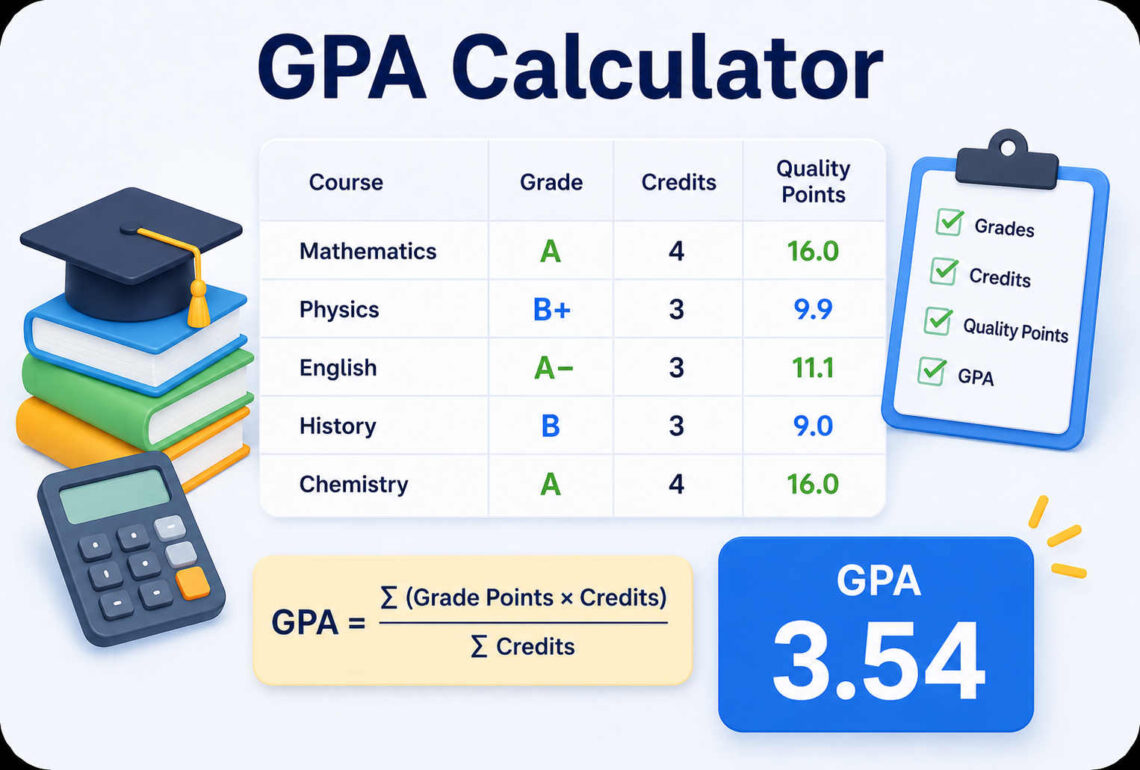
A GPA Calculator (Grade Point Average Calculator) is an online tool that helps students calculate their average academic performance by converting course grades into grade points and calculating an overall Grade Point Average.
GPA is one of the most important measurements used in education systems around the world. Schools, colleges, and universities use GPA to evaluate students’ academic achievement, determine eligibility for scholarships, review admission applications, and check graduation requirements.
Instead of manually converting every grade and performing calculations, a GPA Calculator allows students to enter their courses, grades, and credit hours to quickly calculate their current GPA.
Whether you are a high school student preparing for college applications, a university student tracking academic progress, or someone applying for scholarships, a GPA calculator provides a simple way to understand your academic standing.
What Is GPA?
GPA stands for Grade Point Average.
It is a numerical representation of a student’s average academic performance. Instead of showing only individual grades, GPA combines multiple course results into one standardized score.
For example, a student may have the following grades:
| Subject | Grade |
|---|---|
| Mathematics | A |
| Biology | B |
| History | A |
Each letter grade is converted into a grade point:
| Letter Grade | Grade Point |
|---|---|
| A | 4.0 |
| B | 3.0 |
| C | 2.0 |
The GPA is then calculated by averaging those grade points.
In many education systems, GPA is based on a 4.0 scale, where:
- 4.0 represents excellent performance
- 3.0 represents good performance
- 2.0 represents average performance
- 1.0 represents weak performance
- 0 represents failing grades
However, GPA systems vary between schools and countries. Some institutions use weighted GPA systems with a maximum value above 4.0.
Why GPA Matters
GPA is more than just a number. It is often used as a quick indicator of academic performance and consistency.
Students may need GPA information for:
College Admission
Universities often review GPA as part of the admission process.
A strong GPA can demonstrate:
- Academic ability
- Study discipline
- Consistent performance
- Readiness for advanced coursework
Competitive universities usually receive applications from students with high GPAs.
Scholarships
Many scholarships have GPA requirements.
For example, a scholarship may require:
- Minimum GPA of 3.0
- GPA above 3.5
- Maintaining a specific GPA during enrollment
Students can use GPA calculators to monitor whether they meet these requirements.
Graduation Requirements
Schools may require students to maintain a minimum GPA to graduate.
Some programs may also require:
- Overall GPA requirements
- Major-specific GPA requirements
- Minimum grades in important courses
Academic Planning
A GPA calculator helps students answer questions such as:
- What is my current GPA?
- What GPA do I need next semester?
- How will a new grade affect my average?
- Can I raise my GPA before graduation?
How GPA Is Calculated
GPA calculation usually involves three steps:
- Convert grades into grade points
- Multiply grade points by course credits
- Divide total points by total credits
The exact method depends on whether the GPA is weighted or unweighted.
Basic GPA Formula
A simple GPA calculation averages all course grade points equally.
Example:
A student takes three courses:
| Course | Grade | GPA |
|---|---|---|
| Math | A | 4.0 |
| English | B | 3.0 |
| Science | A | 4.0 |
Calculation:
(4.0 + 3.0 + 4.0) ÷ 3
Final GPA:
3.67
This is an unweighted GPA because each course has the same importance.
Weighted GPA Formula
Weighted GPA considers course difficulty and credit hours.
The formula is:
Total Quality Points ÷ Total Credit Hours
Example:
| Course | GPA | Credits |
|---|---|---|
| Mathematics | 4.0 | 4 |
| English | 3.0 | 2 |
| Physics | 4.0 | 3 |
Calculate quality points:
Mathematics:
4.0 × 4 = 16
English:
3.0 × 2 = 6
Physics:
4.0 × 3 = 12
Total:
34 points
Total credits:
9
GPA:
34 ÷ 9 = 3.78
The final GPA is:
3.78
Unweighted vs Weighted GPA
There are two common GPA systems.
Unweighted GPA
An unweighted GPA treats all courses equally.
The maximum is usually:
4.0
Example:
Regular Biology A = 4.0
Regular Math A = 4.0
The difficulty of the class does not change the GPA.
Weighted GPA
Weighted GPA gives extra value to advanced courses.
For example:
Regular course:
A = 4.0
Honors course:
A = 4.5
AP course:
A = 5.0
Weighted GPA rewards students who take more challenging classes.
This is why some students may have GPAs higher than 4.0.
4.0 GPA Scale Explained
The 4.0 GPA scale is the most common system used in the United States.
A typical conversion looks like this:
| Grade | GPA |
|---|---|
| A | 4.0 |
| A- | 3.7 |
| B+ | 3.3 |
| B | 3.0 |
| B- | 2.7 |
| C+ | 2.3 |
| C | 2.0 |
| D | 1.0 |
| F | 0 |
A GPA close to 4.0 usually indicates excellent academic performance.
5.0 GPA Scale Explained
Some schools use a 5.0 GPA scale.
This system is usually associated with weighted courses.
Example:
| Course Type | A Grade |
|---|---|
| Regular | 4.0 |
| Honors | 4.5 |
| Advanced | 5.0 |
The goal is to recognize students who choose academically difficult courses.
A student with a 4.5 GPA may not have higher grades than a 4.0 student, but may have taken more advanced classes.
Letter Grade GPA Conversion Table
Many GPA calculators use letter grades.
Common conversion:
| Letter Grade | GPA |
|---|---|
| A+ | 4.0 |
| A | 4.0 |
| A- | 3.7 |
| B+ | 3.3 |
| B | 3.0 |
| B- | 2.7 |
| C+ | 2.3 |
| C | 2.0 |
| D | 1.0 |
| F | 0 |
Different schools may adjust these values.
Always check your institution’s grading policy.
Percentage to GPA Conversion
Some students need to convert percentage scores into GPA.
Example:
| Percentage | Approximate GPA |
|---|---|
| 95–100 | 4.0 |
| 85–94 | 3.5–3.9 |
| 75–84 | 2.5–3.4 |
| 65–74 | 1.5–2.4 |
However, percentage conversion is not universal.
A 90% score may equal:
- 4.0 GPA at one school
- 3.7 GPA at another school
Official applications should always follow the required conversion rules.
High School GPA Calculator
A High School GPA Calculator is designed for secondary school students.
High school GPA is commonly used for:
- College applications
- Scholarships
- Academic ranking
High school GPA often includes:
- Regular classes
- Honors classes
- AP classes
- Advanced courses
Many high schools use weighted GPA because advanced courses require more effort.
College GPA Calculator
A College GPA Calculator focuses on university-level grades.
College GPA usually depends heavily on:
- Course credits
- Semester grades
- Major requirements
Example:
A 4-credit engineering course affects GPA more than a 1-credit elective.
College GPA is commonly used for:
- Graduation
- Graduate school applications
- Internships
- Academic standing
Semester GPA Calculator
Semester GPA measures performance during one academic term.
Example:
Fall semester:
GPA = 3.5
Spring semester:
GPA = 3.8
Semester GPA helps students understand short-term academic progress.
Cumulative GPA Calculator
Cumulative GPA includes all completed coursework.
Example:
Year 1:
GPA = 3.4
Year 2:
GPA = 3.7
Year 3:
GPA = 3.8
The cumulative GPA combines all semesters together.
It provides a complete picture of academic performance.
How to Use GPA Calculator
Using a GPA calculator is usually simple.
Step 1:
Enter each course name.
Step 2:
Select the grade received.
Step 3:
Enter course credits.
Step 4:
Choose the GPA scale.
Step 5:
Calculate your GPA.
The calculator will display your result automatically.
GPA Prediction and Improvement
Many GPA calculators can help students estimate future results.
For example:
Current GPA:
3.2
Goal GPA:
3.6
A calculator can estimate what grades are needed in future semesters.
Ways to improve GPA include:
- Improving study habits
- Prioritizing difficult courses
- Seeking academic support
- Managing course workload
Because GPA is cumulative, improving it becomes harder as more credits are completed.
What Is a Good GPA?
A “good” GPA depends on the school, program, and goal.
General guideline:
| GPA | Description |
|---|---|
| 3.8–4.0 | Excellent |
| 3.5–3.7 | Very strong |
| 3.0–3.4 | Good |
| 2.0–2.9 | Average |
| Below 2.0 | Needs improvement |
Different fields may have different expectations.
GPA for College Admission
Universities consider GPA together with:
- Test scores
- Activities
- Essays
- Recommendations
- Course difficulty
A higher GPA generally improves admission competitiveness.
However, schools may evaluate GPA differently depending on grading systems.
GPA for Scholarships
Scholarship organizations often use GPA as a qualification factor.
Common requirements include:
- Minimum GPA
- Maintaining GPA during study
- Academic achievement standards
A GPA calculator helps students track whether they are meeting requirements.
Common GPA Questions
Can GPA be higher than 4.0?
Yes.
Weighted GPA systems can exceed 4.0 because advanced courses receive extra points.
Is a 3.5 GPA good?
A 3.5 GPA is generally considered strong, but expectations vary by school and program.
Does GPA include every class?
Usually yes, but some institutions calculate GPA differently.
Can one bad grade lower GPA?
Yes.
Because GPA is an average, a low grade can affect the overall result.
FAQ
What is the purpose of a GPA calculator?
A GPA calculator quickly converts grades into GPA and helps students track academic performance.
Is GPA the same everywhere?
No. Different schools use different grading scales and conversion methods.
How often should I calculate GPA?
Students can calculate GPA after each semester or whenever new grades are available.
Can GPA calculators be used for college applications?
Yes, but official applications should follow the institution’s own GPA calculation rules.
Conclusion
A GPA Calculator is a useful academic tool that simplifies the process of calculating Grade Point Average.
It helps students understand their academic performance, plan future coursework, prepare applications, and track progress toward academic goals.
Whether calculating a high school GPA, college GPA, semester GPA, cumulative GPA, weighted GPA, or unweighted GPA, a GPA calculator provides a fast and convenient way to evaluate grades.
Understanding how GPA works allows students to make better academic decisions and prepare more effectively for future opportunities.