
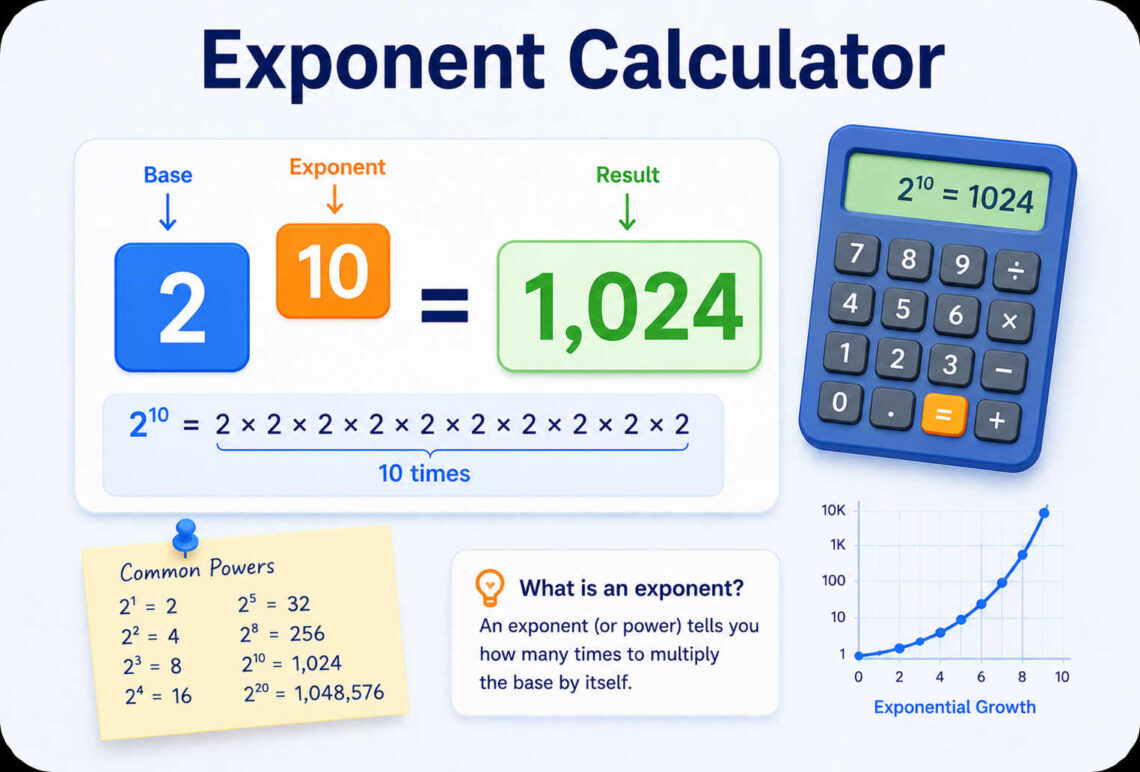
3 to the power of 3 is 27.
When learning exponentiation, expressions like “3 to the power of 3” may seem like a simple multiplication problem. However, powers are one of the most important mathematical concepts behind growth patterns, computer science, probability, geometry, and many real-world systems.
The expression 3³ represents multiplying 3 by itself three times:
3³ = 3 × 3 × 3 = 27
This guide explains what 3 to the power of 3 means, how to calculate it, common mistakes, exponent rules, and practical applications.
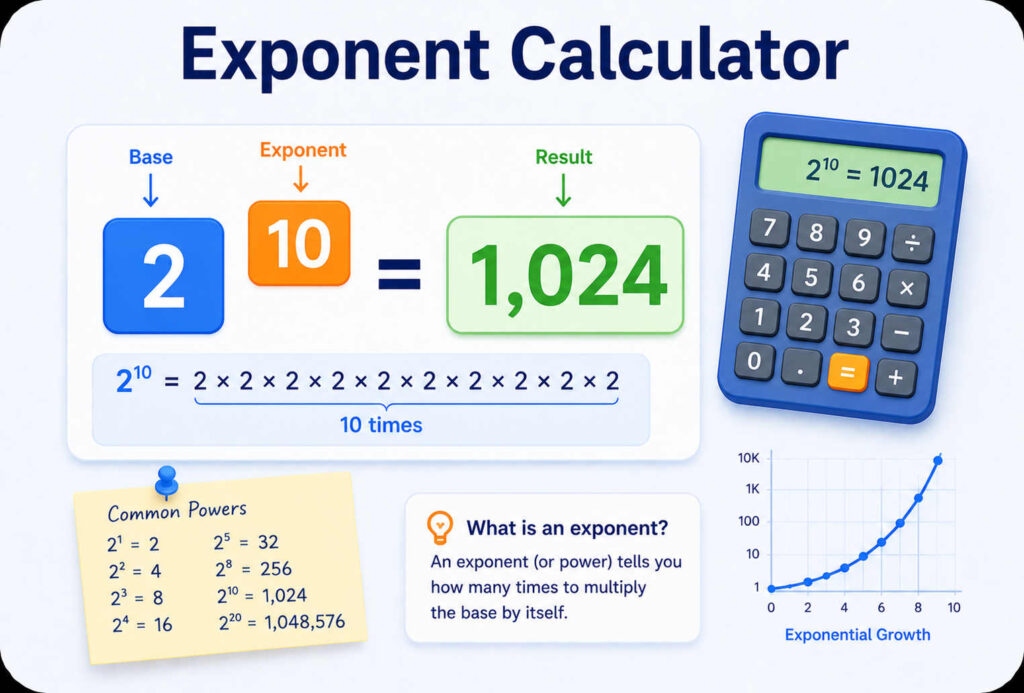
What Does 3 to the Power of 3 Mean?
The expression 3 to the power of 3, written as 3³, has two parts:
- 3 is the base
- 3 is the exponent (or power)
The exponent tells us how many times to multiply the base by itself.
So:
3³ = 3 × 3 × 3
First multiplication:
3 × 3 = 9
Second multiplication:
9 × 3 = 27
Therefore:
3³ = 27
The key idea is that exponentiation is repeated multiplication, not repeated addition.
Step-by-Step Calculation of 3³
Calculating 3³ is straightforward:
Step 1: Identify the base
The base is:
3
Step 2: Apply the exponent
The exponent is:
3
This means three factors of 3:
3 × 3 × 3
Step 3: Multiply
3 × 3 = 9
9 × 3 = 27
Final Answer:
3³ = 27
Understanding Cubes: Why 3³ Is Special
The power of 3 is called a cube because the exponent is 3.
A cube represents three-dimensional multiplication:
Length × Width × Height
For example, a cube with:
- length = 3 units
- width = 3 units
- height = 3 units
has volume:
3 × 3 × 3 = 27 cubic units
So 3³ = 27 can also represent the volume of a 3-by-3-by-3 cube.
Powers of 3 Pattern
Like powers of 2, powers of 3 follow a predictable growth pattern:
| Expression | Calculation | Result |
|---|---|---|
| 3⁰ | 1 | 1 |
| 3¹ | 3 | 3 |
| 3² | 3 × 3 | 9 |
| 3³ | 3 × 3 × 3 | 27 |
| 3⁴ | 3 × 3 × 3 × 3 | 81 |
| 3⁵ | 3 × 3 × 3 × 3 × 3 | 243 |
| 3⁶ | 3 × 3⁶ | 729 |
Each time the exponent increases by 1, the previous result is multiplied by 3.
For example:
3⁴ = 3³ × 3
81 = 27 × 3
Real-World Applications of 3³
1. Three-Dimensional Space and Geometry
One of the most natural applications of 3³ is measuring volume.
A cube with sides of length 3 has:
Volume = 3³ = 27
This concept appears in:
- architecture
- engineering
- physics
- computer graphics
Whenever an object has three dimensions, cubic measurements are involved.
2. Combinations and Possible Outcomes
Suppose you have three choices in each of three independent categories.
Example:
A password system has:
- 3 possible first characters
- 3 possible second characters
- 3 possible third characters
Total combinations:
3 × 3 × 3 = 27
Therefore, there are:
27 possible combinations
This is the same mathematical idea behind many counting problems.
3. Base-3 Number Systems (Ternary)
Unlike computers that commonly use binary (base-2), a base-3 number system uses three symbols:
0, 1, and 2
With three ternary digits, the number of possible combinations is:
3³ = 27
This means:
A 3-digit ternary system can represent 27 different values.
The values range from:
0 to 26
because counting starts at zero.
4. Probability Problems
If an event has three possible outcomes and it happens three times, the total outcome possibilities are:
3³ = 27
For example:
Rolling a three-sided die three times:
First roll: 3 possibilities
Second roll: 3 possibilities
Third roll: 3 possibilities
Total:
3 × 3 × 3 = 27 outcomes
5. Data Structures and Computing
While computer systems often prefer powers of 2 because hardware uses binary, powers of 3 can still appear in algorithms and mathematical models.
For example:
- recursive algorithms
- branching structures
- search problems
A three-level decision tree with three branches at each level contains:
3³ possible paths
which equals:
27 possible outcomes
Comparing 3³ With Other Powers
Understanding exponent comparison helps build intuition.
Example:
Which is larger?
3³ or 2⁵?
Calculate:
3³ = 27
2⁵ = 32
Therefore:
2⁵ is larger than 3³ by 5
Even though 3 has a larger base, the higher exponent of 2 makes the result bigger.
Common Mistakes When Calculating 3³
Mistake 1: Multiplying the Base by the Exponent
Wrong:
3³ = 3 × 3 = 9
Correct:
3³ = 3 × 3 × 3 = 27
The exponent tells the number of factors, not multiplication.
Mistake 2: Adding Instead of Multiplying
Wrong:
3³ = 3 + 3 + 3 = 9
Correct:
3³ = 27
Exponentiation uses multiplication.
Mistake 3: Confusing 3³ With 3 × 3
3 × 3 means:
3²
not:
3³
3³ contains three factors.
Exponent Rules Related to 3³
Multiplication Rule
When multiplying powers with the same base, add exponents:
3³ × 3² = 3⁵
Because:
(3 × 3 × 3) × (3 × 3)
equals:
3 × 3 × 3 × 3 × 3
= 243
Division Rule
When dividing powers with the same base, subtract exponents:
3⁵ ÷ 3³ = 3²
243 ÷ 27 = 9
Power Rule
When raising a power to another power, multiply exponents:
(3³)² = 3⁶
3⁶ = 729
Negative Powers of 3
A negative exponent means taking the reciprocal:
3⁻³ = 1 / 3³
Therefore:
3⁻³ = 1/27
or approximately:
0.037037
How to Calculate 3³ Quickly
Method 1: Memorize Small Cubes
Common cubes:
2³ = 8
3³ = 27
4³ = 64
5³ = 125
Knowing these helps with mental math.
Method 2: Break It Down
Since:
3² = 9
then:
3³ = 3² × 3
= 9 × 3
= 27
Frequently Asked Questions
What is 3 to the power of 3?
3 to the power of 3 equals:
27
How do you write 3 to the power of 3?
It can be written as:
- 3³
- 3^3 (programming format)
- three cubed
Is 3³ the same as 9?
No.
3² = 9
3³ = 27
The exponent changes the number of multiplications.
What comes after 3³?
The next power is:
3⁴ = 81
Each step multiplies the previous result by 3.
Why is 3³ important?
3³ appears in:
- volume calculations
- counting problems
- probability
- computer algorithms
- number systems
It is a simple example of exponential growth.
Conclusion
The expression 3 to the power of 3 is a small but important mathematical concept.
The calculation:
3³ = 3 × 3 × 3 = 27
shows how exponential notation represents repeated multiplication.
Beyond basic arithmetic, 3³ appears in geometry, probability, computing, and mathematical modeling. Understanding this concept helps build a foundation for learning larger exponential patterns and more advanced mathematics.
A simple equation:
3³ = 27
demonstrates one of the most powerful ideas in mathematics: small increases in exponents can create large increases in values.